

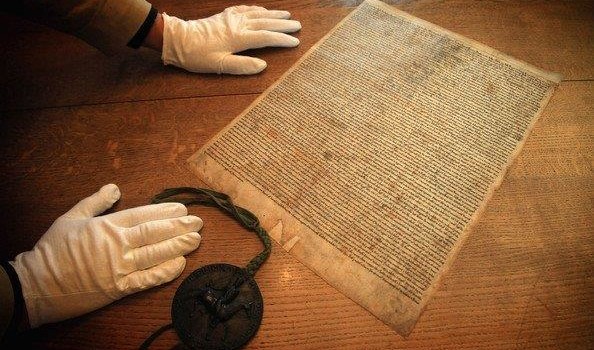
The original Magna Carta was written in 1215, as a short-term political treaty on which King John placed his seal. All copies were hand written on vellum (calf skin) parchment. None of its original writers, nor signatories, could have foreseen that the document they were writing would last 800 years.
King John obviously did not intend for Magna Carta to have a lasting effect, as he renounced it almost immediately. He and many Barons who signed Magna Carta launched into a war that then led to his death. Nor had many Barons expected the document to be honored.
Anything that is 800 years old deteriorates. How many versions of Magna Carta existed is unknown. Only four versions of the original 1215 document survive. King John’s death gave Magna Carta greater importance as versions were reissued by heirs to the throne to bolster their own political legitimacy. Versions were reissued by the regents for King John’s son and heir to the throne, Henry, in 1216 and 1217, and by King Henry III himself in 1225. Henry’s son Edward I did so as well in 1297 and 1300, confirming Magna Carta as the basis of English law. Durham Cathedral’s version of Magna Carta from 1300 will be visiting Canada this year.
In some ways it is miraculous that the remaining versions of Magna Carta have survived at all. Magna Carta copies were sent to public locations, as public documents. Magna Carta is written on parchment, which is especially susceptible to light, humidity, and pollution damage, and temperature changes. Left in open air, materials like parchment degrade, damaged by oils, moisture and damp air, that react with the elements in the document itself.
In the 21st Century, extreme care is required to preserve the 800 year old Magna Cartas. They are protected within specifically climate controlled display cases - some sealed with gases like Argon to ensure that oxygen doesn’t slowly eat away at the documents. These cases are rarely opened, and when they are, they are handled by specialists under very controlled conditions.
This explains why every copy of the Magna Carta on display - and the accompanying 1300 Charter of the Forest on this Canadian tour- are preserved within presentation cases, allowing the documents to be viewed, but protected from the elements, and ensuring their future survival for future generations.
Will Fripp
Information Research, Writing and Investigative Analysis
 Return to home

Michael Andrew David du Frane
June 8, 2015 at 04:27Can you tell me the relevance to the 1215 Magna Carta and the existing Métis First Nations of Canada?!
John Dolson
June 12, 2015 at 18:33It's pretty exciting to have the Magna Carta in Canada. I'll definitely be going to see it. Below, I've pasted a sentence from your text. There are a couple of typos in that sentence that should be corrected. "spm" and "Ling" Versions were reissued by the regents for King John’s spm and heir to the throne, Henry, in 1216 and 1217, and by Ling Henry III himself in 1225.
Greg Gale
June 15, 2015 at 13:43Why can't we see close-up pictures of the document on this web site. Not everyone is able to travel to one of the stops on its tour. I think we all have a right to see it and read it if it really is a foundational document of our justice system.
Charlene San
September 9, 2015 at 16:36I am with the calligraphy guild in Toronto. We are interested in the document as an example of an ancient manuscript. The above article about the preservation of an 800 year old document is the kind of angle we are interested. We would like to see the document with respect to the penmanship, materials & ink used, etc. Is there any such information available?