

“King John was not a good man, and no good friends had he. He stayed in every afternoon, but no-one came for tea.” – A.A. Milne, “Now We Are Six,” 1927.
Nearly eight hundred years after Magna Carta, King John lives on in popular culture as a villain of stage, screen, and historical fiction. In contrast to other controversial Kings of England, such as Richard III, there is no revisionist portrait of John as a misunderstood or unfairly maligned King. Fictional portrayals of John from Shakespeare to the Robin Hood legends always depict him as a deeply flawed man and King. In contrast to this unchanging portrayal of John, the significance of Magna Carta has evolved in the popular imagination. Over the centuries, the Charter has been ignored because of its subversive potential, presented as a necessary check on a King’s power, and glorified for its supposed guarantee of individual liberties.
John emerged as a historical figure of interest for playwrights in Tudor times. Like Henry VIII and Elizabeth I, John quarrelled with the Papacy during his reign and was excommunicated. William Shakespeare wrote King John in the 1590s, inspired by The Troublesome Reign of King John by George Peele. Neither play mentions Magna Carta. National Post columnist Barbara Kay wrote in 2011, “Shakespeare’s history play King John omitted the signing of the Magna Carta, of all things, rather like writing a play about George Washington and omitting the American Revolution.”
To the Tudor dramatists writing at the time of the Spanish Armada, however, King John and his rebellious barons seemed equally dangerous to the stability of the realm. The play ends with Richard I’s illegitimate son Philip de Cognac observing that England will only triumph if it remains united. King John was a popular play during the Victorian era and the first depiction of the King in film is an 1899 silent clip of John’s death scene in Act V. Since then, Shakespeare’s depiction of King John has gone out of fashion and the play is rarely staged today. It is however, coming to Canada’s 2014 Stratford Festival.
The Robin Hood legends have had a more lasting impact on the popular perception of John and Magna Carta. Before the sixteenth century, Robin Hood was seen as a man who did not answer to any authority; that changed during Elizabeth I’s reign. The wild outlaw became a nobleman loyal to King Richard. In 1820, Sir Walter Scott’s historical novel, Ivanhoe, added further details, presenting Robin Hood as the Saxon landowner, Robin of Locksley. Scott’s characterization of Robin Hood contributed to a popular perception that Magna Carta represented a return to an older, Anglo-Saxon law code that had been abandoned after the Norman Conquest of 1066.
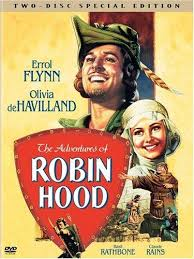
By the 20th century, the legendary Robin Hood was portrayed as part of a national struggle against Prince John’s attempts to usurp his brother Richard’s throne. In the 1938 film, The Adventures of Robin Hood, starring Errol Flynn, a pompous bejewelled Prince John (Claude Rains) announces that he intends to raise taxes, ostensibly to ransom King Richard from the Holy Roman Emperor, and make himself regent of England. The Prince makes a petulant speech to his barons, “Confound it, what are you all gobbling at? Is it so strange that I decide to rule when my brother is a prisoner? Who is to say I shouldn’t!”
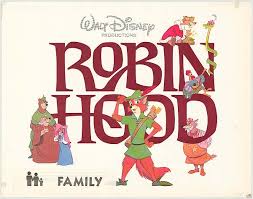
Rains’ portrayal of Prince John as a snivelling traitor set the tone for all subsequent portrayals of the future King in films about Robin Hood. This characterization provides plenty of material for satire. For many children, their first introduction to medieval England is the 1973 Walt Disney Productions animated film, Robin Hood, where Prince John (Peter Ustinov) is shown as a lion without a mane, “a phoney King of England” who sucks his thumb and whines “Mummy always liked Richard best!” The 1993 satirical film directed by Mel Brooks, Robin Hood: Men in Tights, also presented John (Richard Lewis) as a comic villain. At the end of the film, King Richard (Patrick Stewart) returns from crusade and declares to a cheering crowd “Brother, you have surrounded your given name with a foul stench! From this day forth, all the toilets in the kingdom shall be known as… johns!”
Since the Robin Hood films are usually set in the reign of King Richard rather than the subsequent reign of King John, there are rarely explicit references to the Magna Carta. An exception is the 2010 film, Robin Hood, starring Russell Crowe. In the film, Robin’s father is portrayed as a stonemason who was beheaded for his support of a Charter that would guarantee rights for all Englishmen. Later in the film, Robin unifies the nobility by persuading John to sign this Charter. Although the fictional document is far more radical than the historical Magna Carta, the film reflects modern perceptions of the Charter as a guarantee of freedom against tyranny. Oscar Isaac plays John as a more serious figure than in other Robin Hood films but he is still reprimanded by his mother, Eleanor of Aquitaine, and jeopardizes his realm through the pursuit of pleasure.
The depiction of John in the past hundred years of Robin Hood films proved so enduring that it influenced other onscreen depictions of John’s family. In James Goldman’s 1966 play, The Lion in Winter, which was adapted for film in 1968 and for television in 2003, John is a snivelling teenager who is despised by his mother and easily manipulated by his brothers and the King of France. In the 1978 BBC drama series, The Devil’s Crown, John rides to the rescue of his mother at the Siege of Chateau Mirabeau in 1202 then asks, “Am I as good as Richard?” In contrast to most other onscreen depictions of John, The Devil’s Crown follows his reign through a series of villainous, cowardly incidents to 1215 when he affixes his seal to the Magna Carta. The seal cracks the moment it sets, symbolizing his intention to abjure the Great Charter. The 2011 film Ironclad also depicts King John (Paul Giamatti) rejecting Magna Carta and waging war against his barons.
It has been left to historical novelists to add some nuance to the stock depiction of John and Magna Carta in twentieth and twenty-first century films. In Elizabeth Chadwick’s 2010 novel, To Defy a King, the story is told from the perspective of the discontented noble families with only a few scenes from John’s viewpoint. One of the most nuanced portrayals of both King John and the Magna Carta in historical fiction appears in Here Be Dragons, a 1985 novel by Sharon Kay Penman about Llewellyn the Great, Prince of Wales and his marriage to John’s illegitimate daughter, Joanna. In a lengthy conversation about the nature of Magna Carta, the Welsh royal couple place the document in a broader historical context, discussing how John’s extended presence in England as well as his dishonesty contributed to the discontent of the barons.
Llewellyn explains to his wife:
“Henry [II] and Richard both ruled with a heavy hand but they were gone from the kingdom for years at a time, occupied by events in Normandy, Anjou and Poitou. Those absences gave their English barons a needed respite, some breathing space. But for nigh on ten years, John has been anchored in England, riding the length and breadth of the realm, bringing his courts and his constables, collecting taxes, levying scutage, making enemies.”
Through the perspective of Llewellyn, Penman complicates the traditional fictional portrayal of Magna Carta as a charter between a villainous King and his wronged barons. Instead, the very presence of John in England, governing his kingdom rather than being an absentee monarch on the continent or on Crusade, prompted the barons to attempt to codify their traditional prerogatives. After Llewellyn’s explanation, Joanna observes, “You’re saying that the true significance of this charter is that it changes privileges into rights?” Joanna and Llewellyn both agree that Magna Carta is a “novel concept” and that it is a shame that war between the King and his barons seemed inevitable.
In the twenty-first century, the Magna Carta continues to inform popular culture. In July, 2013, rapper Jay-Z exhibited the cover art for his album Magna Carta…Holy Grail in Salisbury Cathedral, next to one of the surviving copies of the Great Charter. The Dean of Salisbury, the Very Reverend June Osborne explained to the Salisbury Journal, “Jay Z, through his album, is creating a huge awareness of this historic document and its modern significance to a huge audience in the run up to its 800th anniversary in 2015. We hope to welcome many of his fans here this summer to see the artwork in the Chapter House alongside our Magna Carta.”
Nearly eight hundred years after King John affixed his seal to Magna Carta, the King and the Charter remain cultural landmarks as writers, artists, musicians and filmmakers continue to be inspired by the universal themes of human rights and the nature of good governance.
 Return to home

Pingback: Review of "King John" at the Stratford Festival (2014) | The View From Bruce